
|
|

|
|
 |
Please join us for the Saturday, March 11 meeting on Zoom, from 10:30 a.m. to noon. Register for the link here: tinyurl.com/WTRA-031123 and learn more about the program here: WITransitRiders.org/Annual-Meeting.
+++
The March LATA Leaders meeting is being rescheduled because of competing important programming on March 8, International Women's Day. If you are interested in joining us for our March meeting, please email LaCrosseTransitAdvocates@proton.me for the new date and time.

Thank you to everyone who helped or participated in this year's Transit Equity Day!
We had some wonderful opportunities to bring this important issue to the front of the conversation and point out how connected it is to almost everything, including climate action, jobs and education, access to health care and services, and communities' and families' finances.
Thanks to local transit advocates who helped make everything happen: Avery, Bridget, Cathy, Joella, Kevin, Liz, Obbie, RoZ, and Sandy. Also thank you to La Crosse labor leader Terry Hicks for allowing us to include highlights of his book, We Walk: A History of the Amalgamated Transit Union Local 519, at the Transit Center display.
Thank you to co-sponsors and supporters, including Citizen Action of Wisconsin Driftless Co-op, Coulee Region Sierra Club, the La Crosse MTU, Onalaska Holmen West Salem Shared Ride Taxi, Planned Parenthood of Wisconsin, Scenic Mississippi Regional Transit, and the Sustainability Institute. And thanks to Western Technical College, the MTU, and the La Crosse Public Library for hosting TED displays.
 |
| Mayor Reynolds' TED proclamation, press event |
 |
| Electeds on the bus! |
Thanks to those who shared their transit rider stories, through the online form, the paper forms, or social media. We hope to have a new Transit Tales page available at this site by February 12. Please check back!
If you missed Transit Equity Day programs, you can watch them here:
If you have comments about this year's event or suggestion for next year or if you would like to help plan future local events with La Crosse Area Transit Advocates, please email us at LaCrosseTransitAdvocates@proton.me or call 608-315-2693.
Finally, if you are a transit rider or advocate, please consider becoming an official member of our group, so we can provide more education, more advocacy, and more support for great public transportation in our area.

Governor Evers' proclamation 
Mayor Reynolds' proclamation
 |
| TED 23 display at La Crosse Public Library |
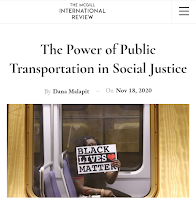
This essay talks about public transit and social justice.
Although the majority of Americans commute to work by car, 21 per cent of urban residents use public transit on a regular basis. However, commuters vary substantially by race and income. In US cities, 34 per cent of Black people and 27 per cent of Hispanic people rely on public transit as their main method of transportation, compared to only 15 per cent of white urban residents.
And, in this piece, 6 Ways to Advance Equity in Public Transportation, Amanda Merck looks at how, sometimes, the wrong things are prioritized which can end up making matters worse.
State and federal tax dollars often pay for projects that widen gaps in access to transportation options for low-income people and people of color.
Transit projects too often focus on economic development and property values.
Moreover, when it comes to equity policy, transit agencies are often only tasked with limiting further harm to people of color─rather than advancing equity.
And, if you have your earbuds along, check out this recorded Transit Chat from Transportation Choices, Transit Funding is Transit Equity.
In this Transit Chat series, we will explore how transit funding is the foundation for transit equity. How are transportation projects currently funded on federal, state, and local levels? How do we secure transit funding to ensure we are moving towards an equitable future (a future that gives everyone the freedom and ability to get where they need to go in an affordable and reliable manner)? And how do we get to a future where fares are free, transit is abundant and ubiquitous, and communities are connected to opportunities to work, play, and thrive?
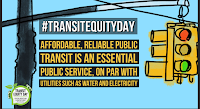
Monday's press event has been rescheduled. Please join us at the Transit Center on WEDNESDAY morning at 10 a.m. for a Transit Equity Day press conference.
Tuesday morning's bus ride with State Senator Brad Pfaff has been postponed due to illness. We are working to reschedule this ride sometime later this week or later this spring.
As of now, all other TED events are running on schedule, including tonight's 7 p.m. online program with Susan Gaeddert, 1000 Friends of Wisconsin and tomorrow's 2 p.m. online Sustainability Chat about local public transit.
We hope, no matter where you are, you will support public transit and consider how we can make our systems better and more accessible for everyone.

The Transit Equity Day Principles are clear. Transit Equity Days in La Crosse are meant to highlight these issues and find how we can work together to improve them. La Crosse Area Transit Advocates agrees with these principles.
TRANSIT EQUITY DAY PRINCIPLES
Public Transit provides basic mobility for many in our communities. It is also essential urban infrastructure–just like roads, bridges, tunnels and utilities–that is crucial to the economic, social and environmental well-being of all our regions. Everyone has a right to a public mass transit system that includes:
1. Safe, reliable, environmentally-sustainable and affordable transit that is accessible
to all, regardless of income, national origin, race, gender identity, sexual orientation, age, religion, or ability.
2. An affordable public transit system that reliably connects people in all communities
to the places we need to travel: home, work, school, places of worship, shopping, health, and recreation, in as efficient, and timely a manner as possible. We must ensure that all communities have access to transit, and not leave any community behind. Regional transportation plans must include public transit in rural, less densely populated communities as well, accounting for the special challenges they may present.
3. Living wages, benefits, safe working conditions, and union rights for transit workers, including those who manufacture transit equipment, and access to family-sustaining transit jobs and training opportunities for people from underserved communities.
4. A just transition for workers and communities who are dependent on our current
automobile and highway-centered transportation system, to ensure that no one is left behind as we transition to a more public, accessible, and cleaner transit-based system.
5. Rapid transition of our transit and school bus systems to electric, non-polluting buses powered by electricity from renewables.
6. Safe, healthy and livable neighborhoods that are connected by public transportation
and by bicycle pathways and sidewalks, and that are planned to expand safe access to transit and reduce single occupancy vehicle miles traveled.
7. Dedicated and sustainable public funding for public transit.
Please join us in supporting transit workers, agencies, and riders during Transit Equity Days by participating in the discussions about what a truly equitable transportation system means and requires.